
The Reserve Bank of India (RBI) on Wednesday announced to increase the policy repo rate by 50 basis points to 4.9 per cent, the second hike in five weeks aimed at quelling the inflation. The MPC vote was unanimous and has decided to keep stance withdrawal from accommodative, RBI Governor Shaktikanta Das said in a press conference on Wednesday. The decision was taken during a three-day meeting of the RBI's Monetary Policy Committee (MPC) to review the interest rates in the country. The MPC voted unanimously to increase the policy repo rate by 50 bps to 4.90 per cent," Das said.

In a tightening cycle, a premature pause in monetary policy action would be a costly policy error, Reserve Bank Governor Shaktikanta Das opined while voting along with five other members of the MPC for raising the key lending rate by 35 basis points earlier this month, according to the minutes of the meeting released on Wednesday. Prior to the December hike in repo rate, the RBI had raised the key short-term lending rate by 190 bps in four tranche.

Large Indian IT services companies are expected to report "muted" sequential show in a traditionally strong second quarter, as macroeconomic challenges continue to weigh on global discretionary spending, say market watchers. The big earnings week for tech heavyweights is up ahead, with Tata Consultancy Services (TCS) scheduled to announce its results on October 11, and both Infosys and HCL Technologies on October 12. Wipro is slated to declare its Q2FY24 results next week, on October 18.

Per capita income in the state has consistently been below the national average for at least 24 years. However, it has narrowed the gap with the all-India level in recent years.

'We are cautious only on sub-sectors that have seen massive melt-up during the past six months.'

Mukherjee said uncertainty was still there on oil prices front due to unrest in West Asia and North Africa.

Following are the highlights of the Economic Survey 2022-23 tabled in Parliament on Tuesday

'Nations like India with high inflation and public debt should be cautious'

Reserve Bank of India (RBI) Governor Raghuram Rajan spoke on a host of issues at his last post-policy interaction with the media

In April, the World Bank had projected India's GDP would grow at 6.1 per cent in the current financial year and at 6.7 per cent the following year.

RICS, the UK-based self-regulatory body for qualification and standards in land, property and construction, said the upward revision in repo rate in October by RBI is likely to increase pressure on real estate developers.
Unfazed by the rising inflation at over 6.0 per cent, Finance Minister Jaswant Singh said on Wednesday that the government was confident it would be contained at 4-4.5 per cent annual average by March end, as projected by the Reserve Bank of India.\n\n
Finance Minister Jaswant Singh on Tuesday projected a growth of 7.5-8 per cent for the fiscal 2003-04 in the face of strong economic fundamentals.

Equity benchmarks Sensex and Nifty on Friday spurted by nearly 2 per cent, propelled by heavy buying in IT, metal and financial stocks amid a rally in global markets after lower-than-expected US inflation data. A strong rupee against the US dollar and unabated foreign capital inflows further bolstered sentiment, traders said. Easing US inflation triggered speculation that the US Federal Reserve might slow down the pace of interest rate hikes.

'.. if you do not want to take the asset allocation call.'' 'This category of funds can offer optimum risk-adjusted returns.'

The biggest risk to India's growth outlook is an escalation of geopolitical tensions, especially if these tensions spread to the Asian region, RBI Monetary Policy Committee (MPC) member Jayanth R Varma said on Wednesday. Varma, in an interview to PTI, said that inflation and inflationary expectations appear to be moderating and high inflation will certainly not become the 'norm' in the country. He is cautiously optimistic about the Indian economy as after the pandemic abated, consumption demand has begun to recover though the recovery is uneven across sectors and industries.

At a time when the market is betting on a 'higher for longer' global interest rate view, Accenture's (ACN) weak revenue forecast is a negative read-through for the Indian IT firms, according to analysts. The Dublin-based company sees its revenue growth at 2-5 per cent in constant currency (cc) for the financial year 2024 (FY24), below the pre-Covid levels of 5-8 per cent for FY17-20. The weak projection, thus, signals that slower demand is likely to persist this year, and any recovery is unlikely in the near-to-medium term, experts note.

Indian economy is projected to grow 7.1-7.6 per cent in the current financial year despite shifting geopolitical realities across the world, a report said on Wednesday. In its India's economic outlook - July 2022 report, leading consultancy Deloitte India said that as 2021 was coming to a close, there was optimism in the air but the optimism received a jolt early this year as a wave of Omicron infections swept through the country and Russia's invasion of Ukraine happened in February. "These events aggravated the pre-existing challenges such as surging inflation, supply shortages, and shifting geopolitical realities across the world with no definite end in sight.

A likely easing in inflationary pressures in the forthcoming months will reopen the window for the RBI to once again prioritise growth and ease its interest rates.

Finance Minister Nirmala Sitharaman will have to do a tight-rope walk between staying fiscally prudent and general public expectations of lower taxes and a wider social security net, while at the same time firing the engines of the economy before general elections. Sitharaman will on Wednesday present her fifth straight Budget at a time when the economy is slowing due to global headwinds and specific sectors need attention. In the run-up to the Budget presentation, expectations are rife that she may tweak income-tax slabs to provide relief to the middle class and increase spending on the poor through programmes such as the rural job scheme while ramping up financial incentives for local manufacturing.

In the coming days, unless Modi tones down the communal spiel, it will be clear that anxiety continues to drive his mind and clouds his judgment, observes Modi biographer Nilanjan Mukhopadhyay.
He also affirmed that over time, as the government finances improve, the SLR will be brought down further.
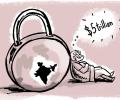
Chief Economic Advisor V Anantha Nageswaran on Thursday expressed hope that the economy will maintain the trend growth rate of 6.5 per cent and above for the rest of the years in the current decade. The economy will close the current fiscal logging in a growth of 6.5-7 per cent, he said, citing the projections of private sector analysts, Reserve Bank of India (RBI) and international agencies like OECD and the IMF. "This appears to be reasonable at this point in time although we will get the data on the fiscal second quarter in a few days, which will give more clarity on these numbers.
Reserve Bank of India Governor Y V Reddy on Thursday said the central bank is keeping a "close watch" on inflation, which is expected to be well below 5.0-5.5 per cent at the end of the current fiscal.

While efforts are being mounted on a war footing to arrest its spread, COVID-19 will impact economic activity in India directly through domestic lockdown. The second-round effects, it said, would operate through a severe slowdown in global trade and growth.

In the five years in politics Priyanka Gandhi has undeniably emerged as a thorn in the BJP flesh, notes Nilanjan Mukhopadhyay. It is time that this thorn is twisted a wee bit more when the elections have become far more uncertain than what it was when the Election Commission announced the poll schedule.

Strong performance by its US subsidiary Novelis and better returns in the copper business helped Hindalco Industries post consolidated revenue growth of 2 per cent quarter-on-quarter (Q-o-Q) to Rs 54,100 crore in the July-September quarter of 2023-23 (Q2FY24). Novelis' Flat Rolled Products (FRP) volumes grew 6 per cent Q-o-Q to 933,000 tonnes (down 5.2 per cent Y-o-Y) on better North American and European volumes. The consolidated earnings before interest, taxes, depreciation, and amortization (EBITDA) declined 2 per cent Q-o-Q to Rs 5,610 crore despite lower input costs in India and better Novelis performance.

India is in a much better position to deal with the challenges related to growth and inflation, said Sanjiv Bajaj, president of industry body CII. According to official figures, India's retail inflation continues to remain above the Reserve Bank's tolerance level of 6 per cent since January, while the economic growth in the first quarter of the fiscal was 13.5 per cent, lower than the central bank's estimate of 16.2 per cent. "I don't want to say we don't have our own challenges with growth, with inflation but we are in a much better position and credit must go to everybody including the central and state governments.

Nifty50's earnings growth, estimated at 20 per cent by global research and brokerage firm Jefferies for financial year 2023-24 (FY24), will be amongst the top three in the Asian region, and is likely to outperform peers. Asean 40 index with 29.1 per cent estimated earnings growth and Straits Times Index (STI) with 29.1 per cent estimated earnings growth are the only two other indices in the Asian region that are likely to outperform India, suggests the recent Jefferies report, coauthored by Mahesh Nandurkar, their managing director along with Abhinav Sinha and Nishant Poddar.

Inflation is estimated to be around 8 per cent in FY15 and is likely to decline further towards 6.5 per cent in FY16, Citigroup said.
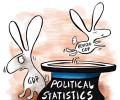
The Economic Survey 2022-23 (FY23), to be presented a day before Union Budget 2023-24 (FY24), is likely to project India's real gross domestic product (GDP) growth between 6 per cent and 7 per cent for FY24, Business Standard has learnt. The broader theme of the Survey could be on how India has dealt with two years of a global pandemic and the ongoing geopolitical disturbance, the strengths and weaknesses that emerged, and what lessons may be learnt. The much-awaited Survey will be the first one by Chief Economic Advisor V Anantha Nageswaran and his team in the finance ministry's economic division.
The gauge for the performance of informational technology (IT) stocks soared nearly 5 per cent-most in nearly three years-as growth worries eased following a robust order book posted by bellwether Tata Consultancy Services (TCS). The Nifty IT index rose 4.5 per cent to close at 30,945. This was the biggest single-day gain since September 14, 2020. Industry titan TCS' shares rose 5 per cent to Rs 3,509.

As markets complete the first half of the calendar year 2022 (CY22) with a fall of around 9 per cent, the interest-rate hike trajectory by global central banks, paired with the conundrum of inflation and growth, will move the needle for the market, observe experts. Here's a quick rundown on what they'll react to over the next six months.
Food inflation continues to run amok, and very clearly, the government does not seem to have any clue on how to rein it in.

The government should not go in for an 'aggressive fiscal consolidation' in the upcoming Budget as global risks have not abated, RBI Monetary Policy Committee (MPC) Member Ashima Goyal said on Wednesday. Goyal further said subsidies are expected to come down as food and energy inflation moderates. WPI inflation in food articles in November was 1.07 per cent against 8.33 per cent in the previous month.

The World Bank on Tuesday revised upwards its GDP growth forecast for India to 6.9 per cent for 2022-23, from 6.5 per cent earlier.
The external environment has worsened further. While the Finnish economy entered into a recession, Swedish economic growth also dipped. The Finnish gross domestic product (GDP) dropped 0.6 per cent in October-December, 2022. It was the second quarter of negative growth, which is a technical definition of recession.

GST rate cut for real-estate, income transfer scheme, farm loan waivers execution and recapitalisation of PSU banks have the potential to boost India's growth in a few months, says Neelkanth Mishra.
The Reserve Bank is likely to maintain status quo on interest rates in its forthcoming monetary policy review but may change the stance in view of retail inflation piercing its upper tolerance limit, global uncertainties created by the ongoing Russia-Ukraine war, and the urgency to protect and boost growth, feel experts. The RBI governor-headed rate setting panel -- Monetary Policy Committee (MPC) -- will be holding its first meeting of the 2022-23 fiscal from April 6 to 8. The outcome will be announced on April 8.
The wait for India to become a $5-trillion economic powerhouse by 2024-25 (FY25) is going to take longer than what the finance ministry had originally intended, according to the International Monetary Fund (IMF). The vision will instead be achieved in 2028-29 (FY29), reveals the IMF data, illustrating a four-year delay. Chief Economic Advisor (CEA) V Anantha Nageswaran had in February said India would become a $5-trillion economy by 2025-26 or the following year, on the back of 8-9 per cent sustained growth rate in real gross domestic product (GDP). However, the IMF data conveys that the economy will be $4.92 trillion in FY28, clearly alluding to the fact that the target will be realised in FY29.
